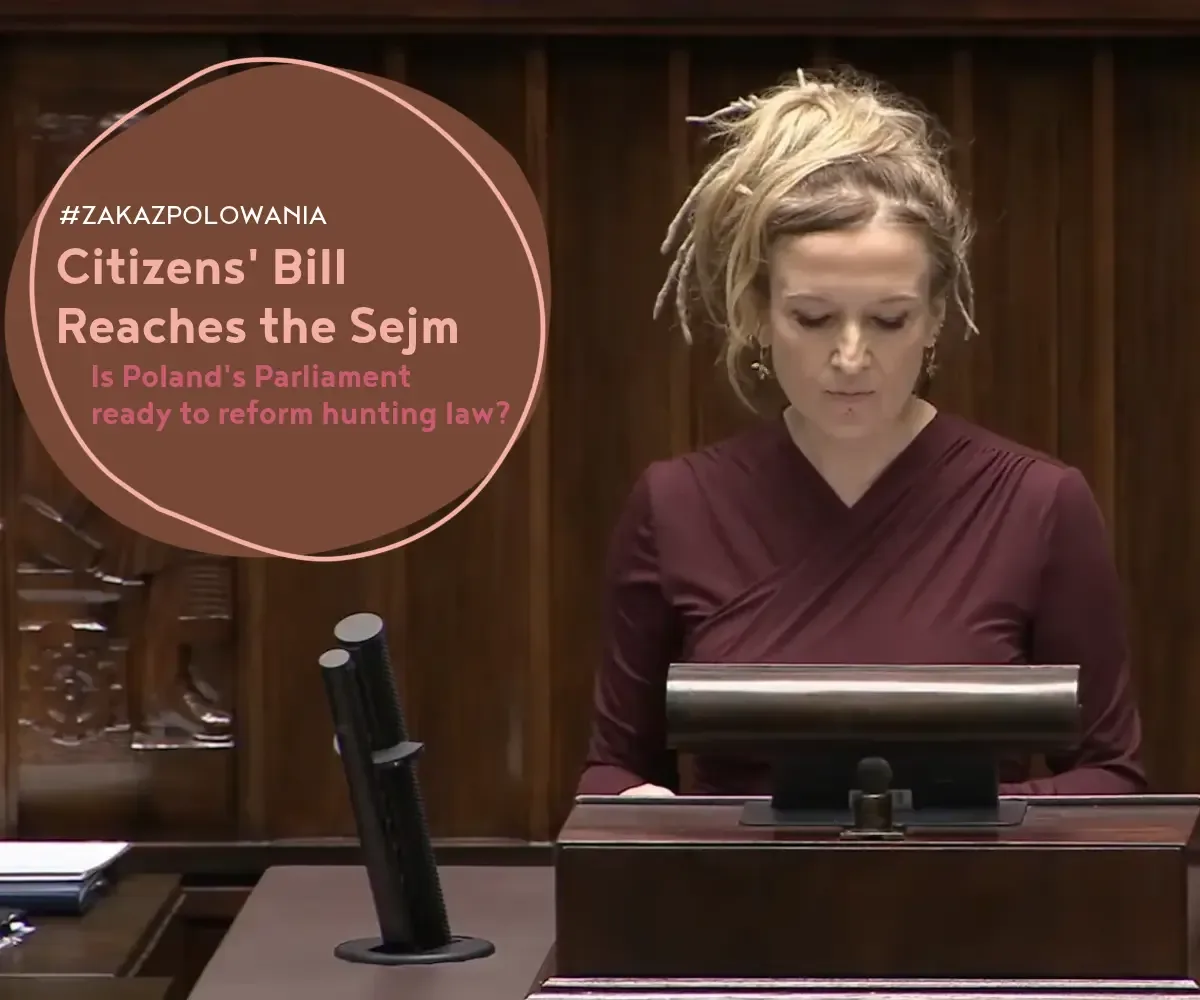
Is Poland's Parliament ready to reform hunting law?
On 19 November 2026, the citizens' bill "WARNING! HUNTING. Let's Change Hunting Law. For Good." came before the Sejm, the lower house of the Polish Parliament. Magdalena Gałkiewicz presented the bill on behalf of the Citizens' Legislative Initiative Committee, after which we heard the positions of the various parliamentary clubs and groups. Watching the proceedings from one side of the public gallery were volunteers from the citizens' initiative committee, whose yellow T-shirts had earlier been confiscated by the Marshal's Guard. On the other side of the gallery sat uniformed officers of the Polish Hunting Association (PZŁ).
Even the hunters themselves thought they had lost the debate. The hunting website Wildmen.pl wrote:
Magdalena Gałkiewicz, representing the authors of the bill, spoke with verve, in a high register, and with considerable rhetorical skill.
Incidentally, the author of that article, looking at the parliamentary rostrum from a distance of 30 metres in a well-lit chamber, managed to mistake the committee's representative... fortunately not for a wild boar, but for one of the female MPs asking questions. He accused Magdalena Gałkiewicz of having "demanded that, should the bill proceed to the committee stage, the chair of that committee be excluded from its work". The fact that no such demand was ever made by the committee's representative can easily be checked in the official parliamentary transcript (pages 407, 422 and 431). Nobody with up-to-date eyesight and hearing tests could reasonably deny it.
While the representative of the 204,000 citizens who had brought the bill before Parliament spoke clearly, factually and to the point, the MPs' subsequent contributions unfortunately demonstrated that most of them had not even read the bill. Instead, they appeared to have drawn their knowledge of it exclusively from the position paper issued by the Polish Hunting Association. As a result, the supposed "ban on hunting within 700 metres of homes" kept coming up, along with claims that it would allegedly exclude 70 or even 80 per cent of Poland's territory from game management.
Of course, this argument is misleading on several levels. The most fundamental problem is that the bill does not introduce an absolute ban at all. Instead, it leaves landowners to decide whether hunting may take place near their buildings. What exactly is the PZŁ so afraid of? That it might finally have to talk to farmers?
Besides, this is precisely the kind of provision that can be discussed and amended during committee proceedings. The proposed distance of 700 metres could be reduced to 500 or even 300 metres.
Another recurring theme was the "cost of game management" and who would bear it. This would be a legitimate argument if we actually knew what those costs are today. But we do not. The public does not know, the relevant institutions do not know, and even the Minister of Climate and Environment does not know. The financial statements of both individual hunting clubs and the PZŁ as a whole are kept out of public view. The data submitted for official statistics are completely unreliable, not to say simply made up out of thin air. Farmers are routinely cheated when wildlife damage is assessed, and have to fight hunting clubs in court to obtain compensation.
The number of organisations and businesses involved in commercial hunting remains a mystery, as does the revenue generated by this business for hunting clubs and the local forest districts of the State Forests. We are all stumbling through a thick fog. The only way out is precisely to adopt the provisions proposed in the citizens' bill: mandatory public reporting by the PZŁ and, more broadly, open and reliable data on game management.
Under the Rules of Procedure of the Sejm, a bill presented to MPs at its first reading should be referred to the appropriate parliamentary committee. That is where the detailed work takes place, often over many months: examining the provisions clause by clause, introducing amendments, and hearing the views of parliamentary legal advisers, invited experts and civil society organisations.
Yet on 19 November, no fewer than four parliamentary clubs (Law and Justice/PiS, the Polish People's Party/PSL, Confederation and Rozwój Plus), together with two smaller parliamentary groups (Direct Democracy and the extreme right-wing Confederation of the Polish Crown), submitted motions to reject the bill outright, without any further examination.
This is like spitting in the faces of the 204,000 voters who brought this bill before Parliament.
The MPs submitted their motions, yet there were not even enough of them in the chamber to vote on them. At most, around 50 parliamentarians were listening to the presentation. Some appeared to be waiting only for their chance to deliver a three-minute speech (and perhaps shout "Darz Bór!", the traditional Polish hunting greeting, to their fellow hunters in the gallery), before promptly abandoning their parliamentary duties. After all, Thursday is practically Friday. They did not even stay to hear the answers to their own questions.
As a result, the decision on how to treat citizens exercising their constitutional right to submit a bill to Parliament will not be taken until 3 December.
The position of the largest parliamentary group, Donald Tusk's Civic Coalition (Koalicja Obywatelska, KO), could prove decisive. Do election promises no longer mean anything to the governing party? If the Civic Coalition fails to vote decisively against the motions to reject the bill, instead lining up alongside Confederation and PiS, its former voters will certainly remember that at the ballot box next year.
The Citizens' Legislative Initiative Committee is encouraging people to email their MPs about the bill:
https://uwagapolowanie.pl/napisz-do-posla/
Video
You can watch the entire Sejm debate here (approximately 2.5 hours, with English subtitles):
https://youtu.be/NA92x41is_s?si=YM98DsXhNMZTy8sl
Further reading:
- How the Polish Right Defends the Hunters' Republic
- Parliament to Decide on Hunting Law Reform in December