Commercial hunting agencies
The Polish model of “game management” is, in theory, based on local hunting clubs which, within the hunting districts they lease, manage populations of wild animals on the basis of multiannual hunting plans prepared by the State Forests and annual hunting plans submitted for approval to the forest district manager. Hunters affiliated with the Polish Hunting Association present their role in this system not even as voluntary activity without which “the animals would simply eat us” — this is a quote from the president of the Supreme Hunting Council, athlete Marcin Możdżonek — but as a compulsory service imposed on them by the State. That is the theory. In practice, it turns out not only that this “service” is extremely profitable (public money flows in a broad stream to hunting clubs), but also that tens of thousands of people in Poland and hundreds of thousands across Europe derive so much pleasure from personally killing animals that they are willing to pay for it — and pay enormous sums. In the “game management” system that has operated continuously since 1953, there are two exceptions. The first is that the Minister of the Environment may exclude selected hunting districts from the normal system of leasing them to hunting clubs and turn them into Game Breeding Centres (OHZ) offering commercial hunts. The second allows foreign tourists to hunt — people who hold no Polish hunting qualifications, are not members of the Polish Hunting Association, but have purchased such a service through a “hunting agency”. Thanks to these two statutory exceptions, an extremely profitable activity — commercial hunting — has existed and expanded for years at the expense of Polish animals.
Commercial hunts do not take place somewhere “on the margins” of the system. They are spread across the entire country and linked to hunting clubs, the State Forests, Game Breeding Centres and private companies.
As part of watchdog activities carried out thanks to the support of the Ludwika and Henryk Wujec Civic Fund, from January to March 2026 we undertook a series of actions to determine the scale of this phenomenon and to check whether state institutions exercise sufficient control over it. To this end, we corresponded with all marshal’s offices, provincial police headquarters and the State Hunting Guard.

Hunting agencies – deregulation that went too far
During the period of the Polish People’s Republic, the state-owned “Orbis” had a monopoly on organising hunts for foreigners (of course in cooperation with the Polish Hunting Association). After the political transformation and the liberalisation of the Act on Economic Activity, from 1989 onwards further such agencies began to appear. The first Voluntary Agreement of Exporters of Foreign-Currency Hunts was established by the following companies:
- Animex (the state-owned pork producer that was later taken over by the Smithfield group),
- Grandel (a company established in 1989 by 35 hunting clubs and State Forests - it continues to operate today),
- Łowex (a company founded in 1989 and wholly owned by the Polish Hunting Association, liquidated in 2024),
- Paged (a state-owned enterprise in the timber industry).
The Hunting Law Act adopted in 1995 finally introduced a requirement to obtain a concession from the Minister of the Environment for the sale of tourist services covering hunts in Poland for foreigners and hunts abroad. In 2004, however, there was a major liberalisation of the regulations governing business activity, and tourist services related to hunting became, under the Hunting Law, a regulated business activity. The obligation to obtain a permit was abolished; instead, mandatory examinations were introduced for persons managing a “hunting agency”, along with mandatory insurance policies and the entry of such activity into a register maintained by the voivode. In 2011, Poland underwent another major liberalisation of business regulations and with it the register of “hunting agencies” disappeared. Since then, an entrepreneur wishing to sell tourist services involving hunting has merely been required to send their insurance policy each year, for purely informational purposes, to the competent marshal of the voivodeship — for reasons that are not really clear.
When the comprehensive Act on Package Travel and Linked Travel Arrangements entered into force in 2017, introducing the Central Register of Tour Operators and Entrepreneurs Facilitating the Purchase of Linked Travel Arrangements (CEOTiPUNPUT), public registers, mandatory insurance guarantees, contributions to the Guarantee Fund and the Assistance Fund, and the requirement that even small non-commercial organisers of, for example, school trips or pilgrimages be entered in the register, the organisers of commercial hunts were forgotten in this Act. These companies claim that their activities fall exclusively under the Hunting Law and that they do not have to be registered in CEOTiPUNPUT or pay contributions. As a result, no state institution has a register or list of such companies. If an entrepreneur does not, on their own initiative, send their insurance policy to the marshal’s office, that office will not know that activity involving the organisation of hunts for tourists is being conducted. Nor will the State Hunting Guard know this. We asked all marshal’s offices for a list of such entities, and ultimately obtained it only after repeated back-and-forth with officials who claimed that they did not hold such data.
Ultimately, based on the data obtained, we were able to compile a list of 175 entities that had notified the competent office of such activity. Of these, 98 are companies or sole proprietorships, and 77 are organisational units of the State Forests. We present these data on the map below. Of course, this map does not show the places where commercial hunts take place, but only the addresses at which hunting agencies are registered (while they may operate throughout the entire country). Is this a complete list? Probably not, because, as already mentioned, if an organiser “forgets” to inform the marshal that they have an insurance policy, there is no other institution that maintains a register of such entrepreneurs.
In the National Court Register and CEIDG databases, it is of course possible to search for entities by a specific PKD activity code, for example 01.70.Z, but this code is not identical with the activity of a hunting tourism organiser. Moreover, merely entering an activity under a given code does not mean that it is actually being carried out. For anyone interested, the CEIDG database contains 1,749 entrepreneurs with the code 01.70.Z, while among entities registered in the National Court Register there are 508 (as of 12 March 2026).
Hundreds of millions in profits unknown to the public
Companies entered in the National Court Register file financial statements, which are public, and on this basis we were able to learn that their annual revenues average around PLN 2 million (approximately EUR 0.5 million). The revenues of companies operating as sole proprietorships are not publicly available. It is therefore impossible to reliably estimate the actual value of this “market segment”. In the most recent publicly disclosed financial report of the Polish Hunting Association, hunting clubs’ revenues from commercial hunts amounted in 2016 — that is, 10 years ago — to a total of PLN 72.5 million (approximately EUR 17 million). More recent data have never been disclosed by the Polish Hunting Association. In reality, however, the revenues of individual hunting clubs are likely to be insignificant compared with the earnings that can be achieved by Game Breeding Centres (OHZ).
What are OHZs? The 1995 Act provided that, in order to restore populations of declining species of wild animals, breed native species of game animals for the purpose of stocking hunting grounds, breed game animals considered particularly beneficial in forest biocoenoses, or conduct research and training, some hunting districts would not be leased to local hunting clubs under the normal rules, but instead would be placed under the management of the State Forests (forest districts), directly under the Polish Hunting Association (not hunting clubs, but the Main Board or district boards), or under scientific institutions. What was supposed to be an exception became the rule, and ultimately more than 160 places were created in the most valuable natural areas and around the largest forest complexes, where wild animals are bred and, at the same time, the sale of a “service” consisting in killing them is conducted. All OHZs are marked on the map below; wherever we were able to find a “hunting offer”, we also provide a link to it. Some forest districts even offer the killing of animals in the form of an online shop, where the customer can choose the date, place and species of animal they wish to kill. The only condition is either membership of the Polish Hunting Association or a declaration of permanent residence outside Poland and the purchase of the service through a “hunting agency” — private, or one operated directly by the forest district itself.
open this map in a new windowTens of thousands of foreign enthusiasts of killing
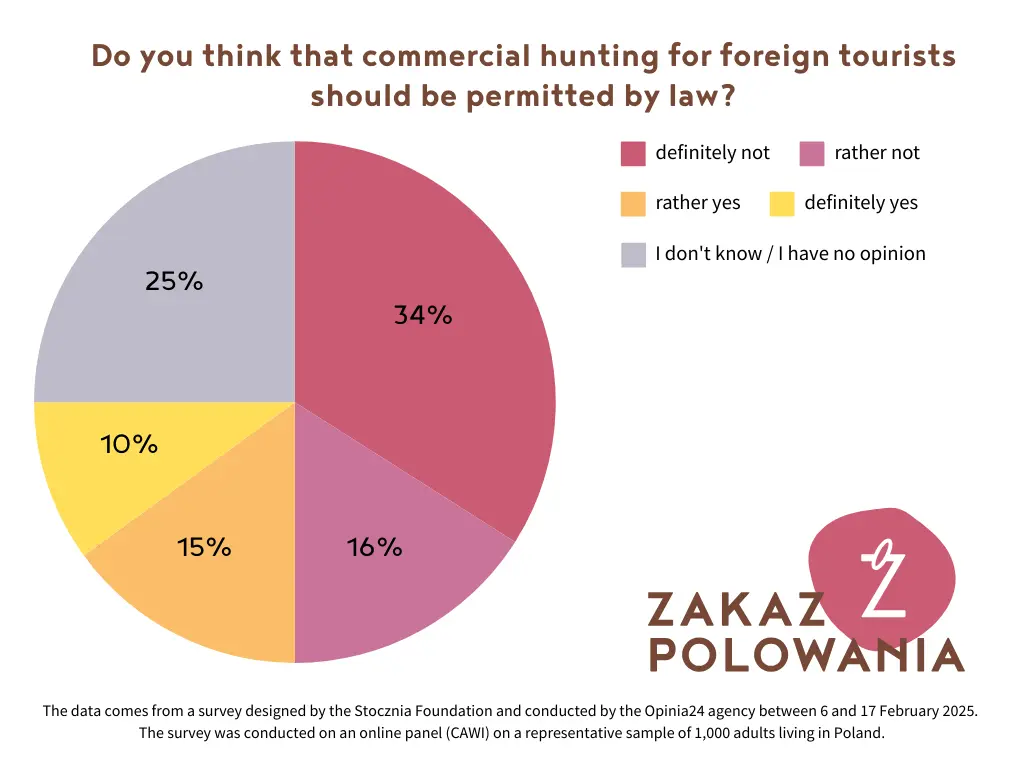
Public opinion is outraged by reports about “trophy hunts” for wealthy tourists in Africa or Asia. At the end of 2025, a parliamentary bill banning the import into Poland of certain hunting trophies even reached the Sejm (Lex Trophy). However, MPs seem not to have noticed that it is Poland itself that has long been a place to which hunters come, kill wild animals here and take parts of their bodies away as trophies. An entire tourism industry is organised around this — not only the 175 “hunting agencies” whose names we managed to establish, but also extensive infrastructure belonging to the State Forests: hunting lodges, hotels and shooting stands built specifically for tourists. According to the data we received from all provincial police headquarters, in 2025 a total of 2,917 hunts involving foreigners were reported. Depending on the voivodeship, organisers reported, on average, the participation of between 3 and 17 foreigners in each such hunt. Altogether, this means that we can speak of at least 12,000 foreigners who came to Poland in 2025 and shot wild animals here — and this is only on the basis of data that were properly reported to the police. That would mean 1,000 people every month, but in reality the hunting season is much shorter (and varies for different animal species), while tourists come to kill animals mainly from August — when the red deer rut begins — until mid-January. It can therefore be said, approximately, that in autumn each day in Poland between 60 and 100 foreign tourists with guns kill animals living in forests and fields. Animals that are sentient and conscious beings; at the same time, as part of wild nature, they are a good of the entire nation, and formally the property of the State Treasury. Yet the owner of a travel agency and the manager of a Game Breeding Centre profit from the killing of each of them. Exactly how much — neither the public nor the Minister of the Environment knows.
In the third decade of the twenty-first century, in a modern European country, is it not finally time to end killing for sport, for pleasure, for profit?