Culling Wild Boar in Cities
Poland’s Hunting Law provides for several forms of killing wild animals that are not legally classified as “hunting” (which means that the legal safeguards and rules that apply to hunting do not necessarily apply). One example is killing carried out in national parks and nature reserves. Another is an unusually vague power granted to the county head (starosta) (or the mayor of a city with county status).
Hunting Law, Article 45(3)
If wild animals create a specific threat to the proper functioning of production facilities and public-utility sites, the county head (starosta), in consultation with the Polish Hunting Association (PZŁ), may issue a decision ordering live capture, live capture followed by killing, or a reduction cull (cull shooting) of wild animals.
When the Hunting Law was adopted in 1995, lawmakers apparently concluded that the state should not rely solely on “hunting management” carried out by recreational hunters. They granted the county head an additional emergency power for situations where wild animals create a “specific threat” to production facilities or public-utility sites. In such cases, the county head—or the mayor of a city with county status—may issue a decision ordering that the animals be killed, by one method or another.
The problem is that the law does not define what “a specific threat” actually means (nor does it define “production facilities”—a phrase that does not appear in other key statutes). Most importantly, it is unclear what type of “decision” this is supposed to be in administrative-law terms. If it is an administrative decision, who is a party to the proceedings—and how are proceedings initiated: on request, or ex officio? Is the decision a command or a permit? Must it specify the area and time period covered—and if so, on what legal basis? This imprecise provision will likely keep lawyers busy for years.
How this works in practice: decisions that do not appear in official registers
We decided to examine how these “decisions” are issued in practice. This is difficult because these are not legal acts that must be published in an official journal or in the Public Information Bulletin (BIP). Offices not only refrain from publicizing such decisions; in some cases they even insert clauses stating that the public and the media must not be informed.
With support from Watchdog Poland, we sent information requests to 380 offices (314 county offices and 66 cities with county status). Most replied (around 30 offices ignored the request or demanded a fee to provide an answer). The map below marks in red the counties where such decisions were issued in 2025. Clicking a county opens a window with additional information (number of decisions, number of animals designated to be killed) and a link to the source document: the office’s written reply.
We asked whether decisions under Article 45(3) were issued at all between 2020 and 2025. It turns out that the majority of county heads (232) issued none. But in the remaining 120 counties (and cities with county status) that responded, 633 such decisions were issued in the last six years. They concerned various animals (roe deer, foxes, birds), but most often they targeted wild boar.
In 2025, local authorities in 52 places issued decisions ordering wild boar to be killed. The number of animals specified ranged from just a few (Słupca County Office) up to 2,000 (the City of Łódź). In Mińsk County and in the city of Grudziądz, the authorities issued decisions for an “unlimited” cull. In Mińsk County, this “unlimited” decision was limited in practice to the grounds of a military airfield. In Grudziądz, by contrast, the mayor issues a decision each year for a reduction cull of wild boar “without any limit” across the entire city—and additionally prohibits making this information public.
A closer look: the Łódź decision (2,000 wild boar)
On 15 April 2025, the Municipal Greenery Authority (Zarząd Zieleni Miejskiej)—a budgetary unit of the City of Łódź—submitted a request to Mayor Hanna Zdanowska for a decision that would allow up to 2,000 wild boar to be killed in the city. The request relied on an internal opinion claiming that Łódź faced an “uncontrolled, rapidly growing” wild boar population, estimated at “over 2,000 individuals”. According to the applicant, the “state of threat” was evidenced by numerous resident reports and a growing number of traffic collisions.
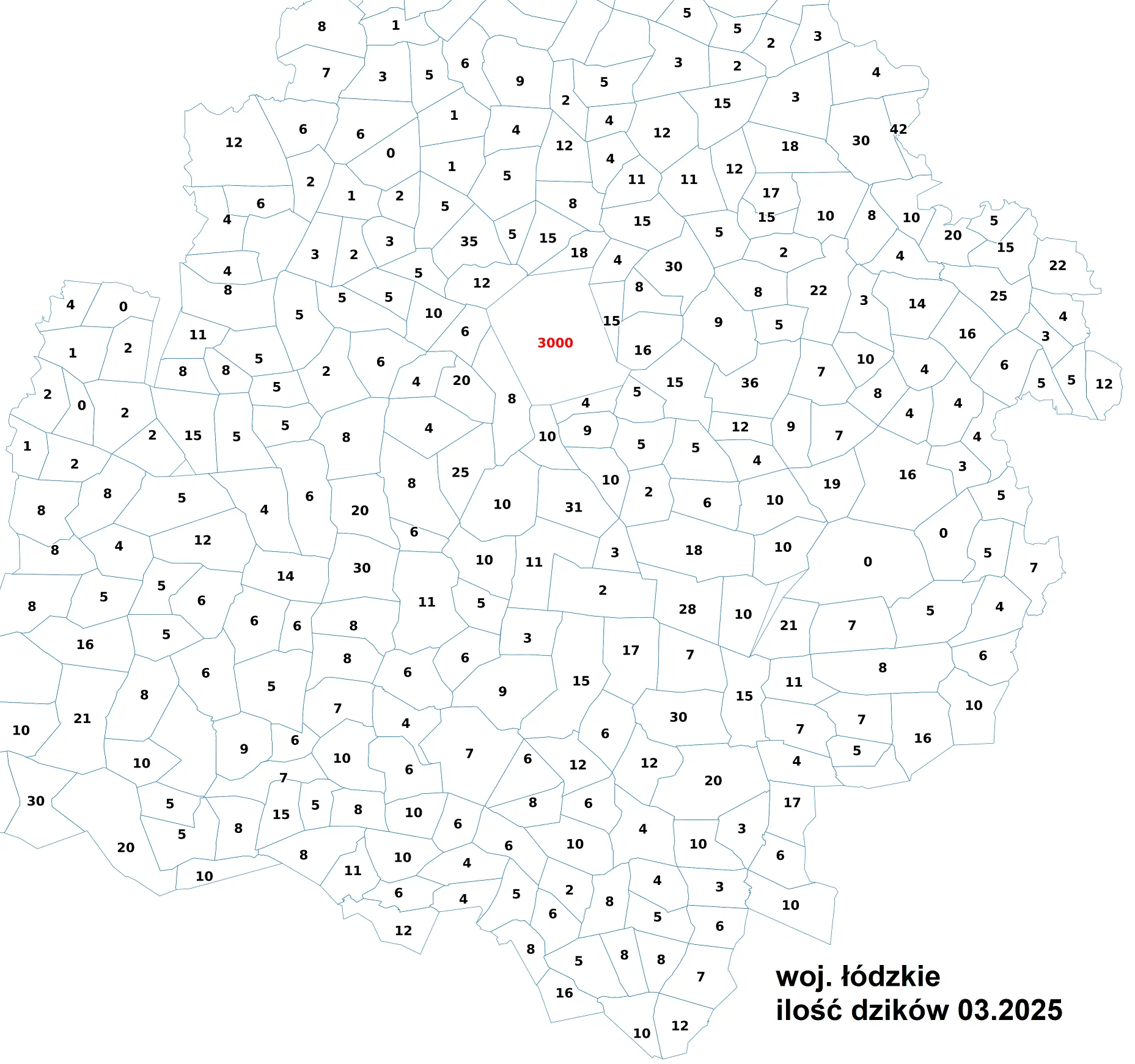
Where did the number 2,000 come from? We do not know. The applicant asserted that roughly that many wild boar lived in Łódź in spring 2025. In December 2025, the city office already cited the population as “over 3,000”. These are estimates: no attempt was made to conduct an actual count (which would likely be difficult and error-prone). Meanwhile, in the hunting districts around Łódź, the managers of hunting districts report wild boar numbers as precise headcounts. According to official figures reported by hunting clubs to the Forest Data Bank (BDL), individual hunting districts near Łódź contained anywhere from a few to several dozen wild boar (as of 31 March 2025, not accounting for reproduction later in the year). The map below shows hunting districts in the region and the reported numbers of wild boar. At the center is the City of Łódź, which is outside hunting districts—where the estimated number of wild boar is said to be higher than in the entire rest of the region combined.
As early as 12 May, the mayor issued a decision in line with the Municipal Greenery Authority’s request. This enabled the city to launch a tender for “intervention services aimed at reducing and disposing of game animals”, and ultimately to sign a contract with company Wildcare to kill 185 wild boar in 2025. The city paid 499,500 PLN (2,700 PLN gross per boar). In 2026 the contract was repeated: by April, another 185 wild boar are to be killed for another 499,500 PLN. Both contracts prohibit the contractor from providing the media with information about how the service is being carried out.
Original documents (in Polish):
- decision of the Mayor of Łódź dated 12 May 2025
- contract to kill 185 wild boar by December 2025
- contract to kill 185 wild boar by April 2026
Residents who see wild boar in housing estates and call the municipal police or the city’s crisis-management center often have no idea that a report can function as a death sentence for these animals. The city does not provide for any alternative procedure other than (1) trapping wild boar in holding pens, or (2) immobilizing the animal with a pneumatic dart device and then (3) killing it with a pharmacological agent—i.e., a live capture followed by killing (a capture-and-kill operation). The contractor is paid 2,700 PLN per animal. Captured wild boar cannot simply be “relocated to the forest”, because sanitary rules—introduced to protect the pork industry from potential African swine fever (ASF) transmission—prohibit such relocation.
A legal tool that enables killing without transparency
This example illustrates how dysfunctional Article 45(3) of the Hunting Law is in practice. It effectively turns city mayors and county heads into decision-makers over life and death for wild animals living in urban areas. Even without reliable population studies, they can issue decisions ordering the killing of a specified number of animals—without meaningful substantive conditions.
Such decisions do not have to be consulted with nature conservation authorities (e.g., the Regional Director for Environmental Protection), do not have to involve animal-protection organizations, and do not have to be published in the Public Information Bulletin (BIP). The only body that must be consulted is the Polish Hunting Association (PZŁ)—whose members can then become paid executors of these decisions. Both the legal framework and the contract terms show that the people who carry out capture-and-kill operations must hold a PZŁ membership card.
In recent years, more than 600 such decisions have been issued across Poland—effectively outside meaningful public oversight.
see also:
Wildlife Magazine “Dzikie Życie”: interview with attorney Karolina Kuszlewicz